Projects CIAN
Team : CIAN
Chaîne de conception et de validation intelligente
Project Leader : Haralampos Stratigopoulos
01/01/2026
ARCHitectures based on unconventional accelerators for dependable/energY efficienT AI Systems
Artificial Intelligence (AI) can power autonomous vehicles, provide strategic advantages through large-scale data analytics, and enable intelligence gathering and surveillance through advanced computer vision, opening a wide range of defence applications.
Conventional Von Neumann architectures, despite their flexibility, are inefficient for AI workloads due to data duplication and data movement bottlenecks, which severely limit the efficiency in the rapid processing of large amount of information and streaming data needed by AI algorithms.
In edge computing devices, crucial for defense applications, this inefficiency is compounded by energy limitations.
To overcome these challenges, specialised hardware and programming paradigm shift are needed to accelerate AI workloads. With the end of Moore’s law and Dennard scaling, simply scaling up existing architectures is no longer viable. Novel architectures are needed to improve performance per Watt and bypass the efficiency limits imposed by the Von Neumann bottleneck.
ARCHYTAS aims to investigate unconventional AI accelerators that take advantage of novel technologies: optoelectronic-based accelerators, volatile and non-volatile processing-in-memory, and neuromorphic devices. These technologies promise to mitigate the Von Neumann bottleneck by integrating processing and memory. ARCHYTAS also explores the integration of CMOS-based systems with analogue accelerators, as well as new programming models to improve the programmability, performance portability, and productivity of these emerging parallel systems through a hardware-AI co-design approach. The technological ambition of ARCHYTAS is to bridge the gaps in multi-modal sensing integration and AI processing, providing solutions that fit the non-functional requirements of future autonomous vehicles for defense applications.
The ARCHYTAS AI accelerators will be validated within the context of defense AI use cases in land, aerial, maritime, and space settings.
Project Leader : Haralampos Stratigopoulos
12/01/2024

Systèmes Bio-inspirés distribués de confiance : bases théoriques et mise en œuvre matérielle
Project Leader : Haralampos Stratigopoulos
10/01/2023

Trusted SMEs for Sustainable Growth of Europeans Economical Backbone to Strengthen the Digital Sovereignty
The internet of things (IoT) is promising as it drives the datafication of our everyday life and thus, leverages synergies between originally considered “dead” things and enables them to proactively serve humans. IoT leads to a high automation potential with which we improve the life of billions of people and compensate for societal problems such as a growingly old population, missing high-skilled labour across Europe or the efficiency limits in current production capabilities. IoT5.0, an Artificial Intelligence (AI) -assisted Internet of Things, could even more benefit society, as the devices could even learn how to provide more value. But the ubiquitous connectivity comes at a cost. Security levels have to rise tremendously to ensure a network stays secure and safe for humans. This additional effort often is a burden for small and medium sized enterprises as the complexity and security demands of such systems rise faster than available resources. This is especially dangerous as a single corrupted, malicious device can result in the exploitation of the entire network of connected devices by an attacker. Consequently, RESILIENT TRUST focuses on end-to-end security of IoT processing chains with a focus on strong exploitation for SMEs. This vision will be realized by developing specialized hardware to establish TRUST in-between a network and a wall of RESILIENCE even against new attack methods such as post quantum attacks and AI based attacks. The architecture of the secure processing chain will be carefully built after threat modelling, asset identification, risk analysis, security objectives and requirements definition. Consequently, RESILIENT TRUST will address and significantly mitigate these major risks to enable IoT5.0. That way this project will be a driver for sustainable development and the generation of convenience and wealth. A solution is proposed to ensure end-to-end security by boosting RESILIENCE and TRUST along different key supply chains of IoT device
Project Leader : Haralampos Stratigopoulos
10/01/2023
A network of excellence for distributed, trustworthy, efficient and scalable AI at the Edge
The vision of dAIEDGE Network of Excellence (NoE) is to strengthen and support the development of the dynamic European edge and distributed Artificial Intelligence (AI) ecosystem as an essential ingredient in the growth and competitiveness of European industrial sectors. The dAIEDGE Network aims to reinforce the research and innovation value chains to accelerate the digital and green transitions through advanced edge AI technologies, applications, and innovations, building on Europe's existing assets and industrial strengths. In parallel, it will fortify the edge AI research and industrial communities through technological developments beyond state of the art and become a dependable and strategic pillar for the European AI Lighthouse. This will be achieved by mobilising and connecting the European AI and edge AI constituency, the relevant stakeholders, European partnerships, and projects, to provide roadmaps, guidelines and trends supporting the next-generation edge AI technologies. The key aim is to support and ensure rapid development, market uptake and open strategic sovereignty for Europe in the critical technologies for distributed edge AI (hardware, software, frameworks, tools). The dAIEDGE NoE will play a catalyst role in building a solid edge AI virtual network of research facilities and laboratories to benefit the European research and industrial community. The NoE multidisciplinary concept provide an arena for matchmaking, exchanging ideas, tools, and services, by bringing together the leading research centres, AI-on-demand platforms, digital innovation hubs, AI projects and initiatives. The ultimate goal for the dAIEDGE NoE is to support Europe to become a global centre of excellence with unique human-centred edge AI competence addressing the social and economic challenges and the needs of the citizens and society.
Project Leader : Haralampos Stratigopoulos
09/01/2023
Compréhension et atténuation d’erreur dans les implémentations analogiques de réseaux de neurones sur silicium
Project Leader : Haralampos Stratigopoulos
10/01/2022
Récupération d'énergie mécanique proche des limites physiques par synthèse adiabatique de la dynamique électromécanique
C23/0800
Project Leader : Dimitri Galayko
10/01/2022
CORIOLIS - Platform for physical synthesis of integrated circuits
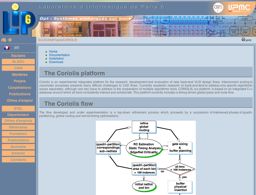
Coriolis is an experimental integrated platform for the research, development and evaluation of new back-end VLSI design flows. Interconnect scaling to nanometer processes presents many difficult challenges to CAD flows. Currently academic research on back-end tend to address only specific algorithmic issues separately, although one key issue to address is the cooperation of multiple algorithmic tools. CORIOLIS, our platform, is based on an integrated C++ database around which all tools consistently interact and collaborate. This platform currently includes a timing-driven global place and route flow.
Project Leader : Jean-Paul CHAPUT
01/01/2004
CAIRO - Analog IP Design
Our purpose is to provide a language for designing generators of analog functions, that can be easily ported to new set of specfications and new technologogy processes. We are currently developing such a language that is called CAIRO+
The CAIRO+ language supports the four steps of a design flow based on net-list and layout templates. This language is aimed to help the designer to capture his knowledge, thus creating a library of layout-aware analog functions. It is based on C++ language. The design flow relevant to CAIRO+ is the following :
->net-list and layout template capture, ->design space exploration (managing electrical constraints) ->shape function computation (managing geometrical constraints) ->layout generation (place and route) CAIRO+ allows creating complex hierarchical analog function generators by using existing generators of simpler functions. It is an answer to the problem of Analog and Mixed IPs.
As a demonstration of the CAIRO+'s capabilities, we are developping Analog to Digital converters, specially Sigma Delta.
Project Leader : Marie-Minerve LOUËRAT
01/01/2004